Service
Non-running car transport
A non-running car can still ship on a standard open carrier if it rolls, steers and brakes; the driver winches it on, and our estimates add a flat $150 for that. Vehicles that cannot roll or steer, or that have no wheels, need a flatbed or forklift-loaded trailer and cost more. Accurate condition details at booking help avoid a carrier’s dry-run fee. Source: HaulFare price model, October 2026 edition.
Updated October 2026
What carriers mean by inoperable
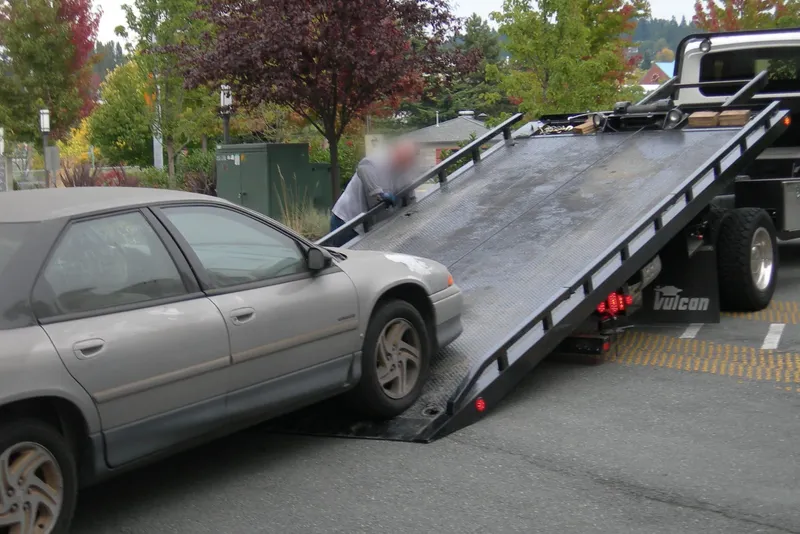
To a dispatcher, “inop” means the engine will not start or the vehicle cannot move under its own power. The crucial secondary question is whether it rolls freely, steers and holds on the brake. If yes, a winch-equipped open hauler handles it. If the wheels are locked, the steering is seized, or the car sits on its frame, it needs a flatbed with a tilt deck or a forklift at a yard.
Preparing an inoperable car for pickup
Make sure the car is accessible from the front or rear with room for a winch cable, the parking brake releases, the key is available, and any loose parts are secured or removed. If the battery is dead but the car otherwise runs, charge or replace it before pickup; a car that starts and drives onto the trailer is priced as running.
The roll, steer and brake test
Before you request a quote, find out which of three things the car can still do, because the answer decides which truck is sent. Rolls: with the transmission in neutral, can two people push it across level ground? On many automatics the key has to be in the ignition and the brake pedal pressed to shift out of park. Tires that are flat but hold air once inflated still count as rolling; a seized wheel or a parking brake stuck on does not. Steers: with the key turned far enough to unlock the column, do the front wheels follow the steering wheel? Brakes: does pressing the pedal slow the car while it is being pushed?
A winch pulls the car up the ramp, but the driver still needs working brakes and steering to stop it and line it up on the deck, so a car that passes all three tests is the standard winch load. One that rolls but cannot steer or stop, or will not roll at all, needs wheel dollies, tire skates, a tilt-deck flatbed or a forklift. Tell the broker exactly which test failed; that detail, more than the word “inoperable”, is what gets the right equipment to your address.
How the winch fee works in our estimates
Our model adds the same flat $150 to any move where the car does not run, whatever the distance, because the extra work happens at the two ends of the trip rather than on the highway. That makes it weigh more on short moves. On a 500-mile open move the estimate rises from $620–$775 to $755–$940, about 22% more, while Los Angeles to New York goes from $1,500–$1,865 to $1,635–$2,035, about 9% more. On an enclosed trailer with a winch and liftgate, a 1,000-mile non-running move estimates at $1,405–$1,745 in October 2026.
The fee assumes a car that passes the roll, steer and brake test and loads by winch. Dollies, skates, a flatbed or a forklift are outside the model, and the broker your request goes to quotes them. The $150 is a model figure too: the actual charge for a non-running car is set by the broker and the carrier that accepts the load, so ask for it in writing with the rest of the price.
Non-running car transport prices by distance
+$150 winch fee in our model. Sedan baseline unless noted; October 2026. For your exact ZIP codes use the car shipping calculator; for every distance, vehicle and month see how much it costs to ship a car.
| Miles | Open carrier | Enclosed |
|---|---|---|
| 500 | $755–$940 | $1,015–$1,265 |
| 1,000 | $1,030–$1,280 | $1,405–$1,745 |
| 1,500 | $1,230–$1,530 | $1,690–$2,105 |
| 2,500 | $1,505–$1,870 | $2,080–$2,585 |
HaulFare price model 2026.09-seed, October 2026. Ranges, not quotes.
- Instant estimate, no email gate
- The licensed broker confirms the actual price before anything is booked
- Free to use: you pay HaulFare nothing
From estimate to delivery
What happens after you ask for a quote, whichever service you choose.

Get your estimate
Enter ZIPs and vehicle details. You see a typical price range instantly, before you share contact information.
Request a quote
If you want a quote, your request goes to our licensed transport partner, an FMCSA-licensed auto transport broker. We send it to that one broker only, never to a list of companies.
Price, dates and carrier
Our licensed transport partner contacts you to confirm the actual price, pickup dates and vehicle details, then books the shipment and assigns an FMCSA-registered carrier. Ask about deposits and payment terms before you book.
Pickup and delivery
The assigned carrier usually calls 12–24 hours ahead. You both sign a Bill of Lading with a condition report at pickup, then check the car against it at delivery. Most shipments arrive in 2–10 days.
Related services
All services


Sources
Non-running car transport FAQ
How much more does a non-running car cost to ship?
Our estimates add a flat $150 for winch loading on top of standard pricing. Cars that do not roll or steer are quoted individually because they need a flatbed, a forklift or extra labor.
Can a non-running car go on an enclosed trailer?
Yes, if the enclosed carrier has a winch and liftgate. Many hard-side enclosed trailers do; confirm at booking.
What is a dry-run fee?
A charge a carrier may make when it arrives and cannot load the vehicle because its condition was misdescribed or it was not ready. Ask the broker about dry-run fees before you book; accurate condition details avoid them.
Can project cars and barn finds be shipped?
Yes. Cars with flat tires, no brakes or no steering are common; describe exactly what works so the right equipment is sent.