Service
Open car transport
Open car transport ships your vehicle on an open-air trailer, usually a two-level hauler carrying several other cars. It is the most common and lowest-cost way to ship a car in the US: about $895–$1,115 for a 1,000-mile sedan move in October 2026 in our model. Cars ride exposed to weather, so check the carrier’s cargo insurance certificate before pickup. Source: HaulFare price model, October 2026 edition.
Updated October 2026
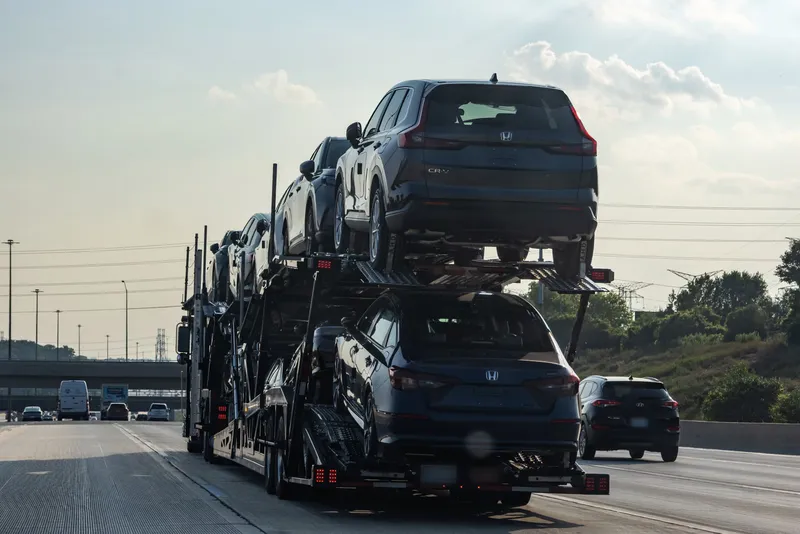
What open transport actually looks like
Open carriers are the double-deck trailers you see hauling new cars to dealerships. A full-size hauler is 75–80 feet long, which is why drivers often ask to meet at a nearby parking lot instead of a cul-de-sac. Smaller 3- to 5-car hotshot trailers handle short and rural runs.
Your car is driven onto the trailer, chocked and usually strapped at the wheels rather than the frame, and its condition is recorded on a Bill of Lading at pickup and delivery. You can print your own condition report to compare.
Cost in 2026
In our model an open sedan move runs about $1.82 per mile at 250 miles, $1.00 at 1,000 miles and $0.58 coast to coast, because loading costs spread over more miles. For October 2026, Los Angeles to Dallas estimates at $1,085–$1,350 and New York to Miami at $1,185–$1,475.
Our seasonal index puts a July move about 16% above the same move in February. Snowbird lanes add 15% in the peak direction and take 7% off against it, a non-running car adds a $150 winch fee, and full-size SUVs and pickups add 20% and 22%.
When open is the right call
Daily drivers, leases, dealer trades, auction purchases, student cars and most relocations: open transport is the sensible default. On an open trailer the car meets the weather and road grit it would meet on the highway, without adding miles.
Consider enclosed instead when the vehicle is worth more than about $70,000 (our rule of thumb), has low ground clearance (under 4 inches), is freshly restored or wrapped, or when you are shipping in winter through road-salt states and cannot wash the car promptly on arrival. The open vs enclosed comparison prices both for your route.
Open car transport prices by distance
Baseline (1.0×). Sedan baseline unless noted; October 2026. For your exact ZIP codes use the car shipping calculator; for every distance, vehicle and month see how much it costs to ship a car.
| Miles | Open carrier | Enclosed |
|---|---|---|
| 500 | $620–$775 | $880–$1,100 |
| 1,000 | $895–$1,115 | $1,270–$1,580 |
| 1,500 | $1,095–$1,360 | $1,555–$1,940 |
| 2,500 | $1,370–$1,700 | $1,945–$2,420 |
HaulFare price model 2026.09-seed, October 2026. Ranges, not quotes.
- Instant estimate, no email gate
- The licensed broker confirms the actual price before anything is booked
- Free to use: you pay HaulFare nothing
From estimate to delivery
What happens after you ask for a quote, whichever service you choose.

Get your estimate
Enter ZIPs and vehicle details. You see a typical price range instantly, before you share contact information.
Request a quote
If you want a quote, your request goes to our licensed transport partner, an FMCSA-licensed auto transport broker. We send it to that one broker only, never to a list of companies.
Price, dates and carrier
Our licensed transport partner contacts you to confirm the actual price, pickup dates and vehicle details, then books the shipment and assigns an FMCSA-registered carrier. Ask about deposits and payment terms before you book.
Pickup and delivery
The assigned carrier usually calls 12–24 hours ahead. You both sign a Bill of Lading with a condition report at pickup, then check the car against it at delivery. Most shipments arrive in 2–10 days.
Related services
All services


Sources
- FMCSA, Insurance Filing Requirements (no federal cargo insurance minimum for non-household-goods carriers), fmcsa.dot.gov
- 49 CFR 393.128, securing automobiles, light trucks and vans (Legal Information Institute), law.cornell.edu
- 23 CFR 658.13, length limits for automobile transporters (Legal Information Institute), law.cornell.edu
Open car transport FAQ
Is my car insured on an open carrier?
Cargo insurance is not federally required for auto haulers. Before pickup, ask the broker for the assigned carrier’s cargo insurance certificate; limits vary by carrier, so compare the per-vehicle limit with your car’s value. A damage claim is made against the carrier’s cargo insurance, not against HaulFare; ask the broker that booked the shipment how it supports claims, and keep the Bill of Lading notes and photos as evidence.
Can I put personal items in the car?
Many carriers allow a small amount of soft items in the trunk or below the window line, at your own risk; the limit varies by carrier. Personal items are not covered by the carrier’s cargo insurance, and carriers will not take hazardous materials. Items above the window line are usually refused or charged extra.
How long does open transport take?
Carriers drive 400–500 miles a day. Our transit model puts 900 miles at 2–3 days, 1,500 miles at 4–6 days and coast to coast at 7–10 days, plus a 1–5 day pickup window while the load is built. The transit time estimator runs your ZIP codes.
Does my car get driven during transport?
Only on and off the trailer. Odometer readings are recorded on the Bill of Lading at pickup and delivery; note any difference of more than a few miles on the delivery Bill of Lading before you sign.