Service
Motorcycle shipping
Motorcycle shipping costs 20% less than a car on the same route in our model, about $715–$890 for 1,000 miles on an open carrier in October 2026. Domestic moves usually travel uncrated, secured with a wheel chock and soft straps, often on enclosed trailers. Open transport is cheaper but exposes the bike to weather; crating adds cost and is mainly used for freight or international moves. Source: HaulFare price model, October 2026 edition.
Updated October 2026
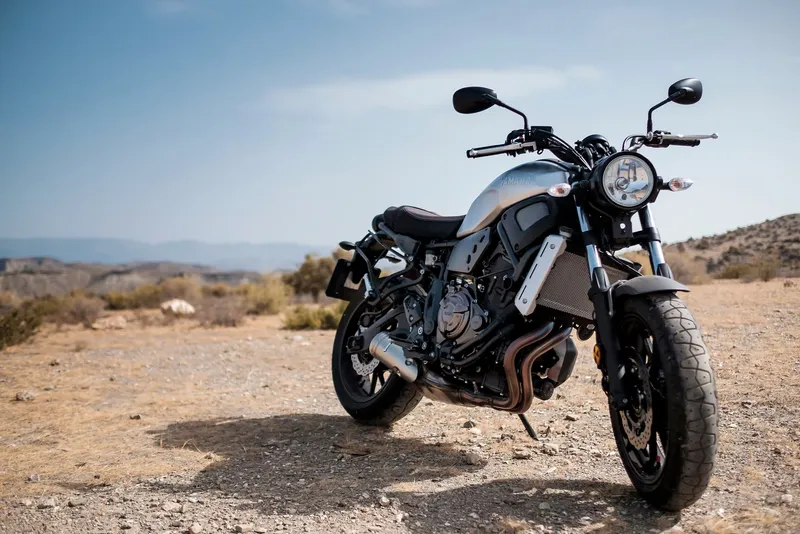
How motorcycles are secured
Motorcycle carriers typically use a front-wheel chock plus soft-loop straps that compress the suspension slightly; the bike is not left on its kickstand. Mirrors, saddlebags and windshields stay on unless they are loose. Fuel should be under a quarter tank and the battery connected.
Enclosed, open, or freight
Enclosed motorcycle trailers are the usual choice for a bike you care about. Open transport on a car hauler is possible and cheaper but less common. Palletised LTL freight requires crating and terminal handling; it can be cheaper for very long moves but adds days and handling. For a trike or a bike with a sidecar, the vehicle transport class lookup shows how the VIN is classed.
Soft-tied or crated
Most domestic bike moves are soft-tied. The front wheel sits in a chock, soft loops go around solid points low on the bike, such as the lower fork legs or the triple clamp, and the ratchet straps hook to those loops rather than to handlebars, levers or painted parts. The straps pull the bike down until the suspension is partly compressed, which holds it upright with no weight on the side stand. The bike stays whole, rolls on and off by ramp or liftgate, and is ready to ride at delivery. Ask the carrier where it attaches the straps on your model, especially on a bike with full fairings or clip-on bars.
Crating means bolting the bike into a frame or onto a pallet so it can travel as freight, lifted by forklift and handled at terminals along the way; the windshield, mirrors or front wheel may have to come off to fit. It suits an export move or a bike with no motorcycle carrier near either end. Freight carriers set their own rules on fuel and batteries in crated vehicles, so ask before you build or buy a crate. Our model covers soft-tied transport only: the 20% motorcycle adjustment gives about $715–$890 open or $1,015–$1,265 enclosed for 1,000 miles in October 2026, and a crate is quoted separately.
What to remove, hand over and record
Take off anything that is not bolted down or that someone could unclip in seconds: GPS units, phone and camera mounts, tank and tail bags, covers and loose tools. Empty the saddlebags and top case, because the carrier’s cargo insurance does not cover personal items and extra weight in a case loads its mounts over a long trip. Leave the windshield and mirrors on unless they are already loose.
Hand the driver every key the bike needs, for the ignition, steering lock, fuel cap and luggage, plus the fob for any immobilizer. A motion alarm can go off again and again on a moving trailer, so switch it off or leave written steps for disarming it. Check tire pressure, since a soft front tire can let the bike shift in the chock, and look for oil or coolant weeps so old drips are not blamed on the trip. Then photograph both sides, the tank, fairings, exhaust and odometer, and list accessories such as crash bars or a tail rack on the Bill of Lading, or fill in a printable condition report with the driver.
Motorcycle shipping prices by distance
0.8× car rate in our model. Sedan baseline unless noted; October 2026. For your exact ZIP codes use the car shipping calculator; for every distance, vehicle and month see how much it costs to ship a car.
| Miles | Open carrier | Enclosed |
|---|---|---|
| 500 | $495–$615 | $705–$880 |
| 1,000 | $715–$890 | $1,015–$1,265 |
| 1,500 | $880–$1,090 | $1,240–$1,545 |
| 2,500 | $1,095–$1,360 | $1,555–$1,940 |
HaulFare price model 2026.09-seed, October 2026. Ranges, not quotes.
- Instant estimate, no email gate
- The licensed broker confirms the actual price before anything is booked
- Free to use: you pay HaulFare nothing
From estimate to delivery
What happens after you ask for a quote, whichever service you choose.

Get your estimate
Enter ZIPs and vehicle details. You see a typical price range instantly, before you share contact information.
Request a quote
If you want a quote, your request goes to our licensed transport partner, an FMCSA-licensed auto transport broker. We send it to that one broker only, never to a list of companies.
Price, dates and carrier
Our licensed transport partner contacts you to confirm the actual price, pickup dates and vehicle details, then books the shipment and assigns an FMCSA-registered carrier. Ask about deposits and payment terms before you book.
Pickup and delivery
The assigned carrier usually calls 12–24 hours ahead. You both sign a Bill of Lading with a condition report at pickup, then check the car against it at delivery. Most shipments arrive in 2–10 days.
Related services
All services


Sources
- NHTSA, vPIC VIN decoder (vehicle type and class), vpic.nhtsa.dot.gov
- FMCSA, Insurance Filing Requirements (no federal cargo insurance minimum for non-household-goods carriers), fmcsa.dot.gov
Motorcycle shipping FAQ
Do I need to crate my motorcycle?
Not for domestic transport with a motorcycle carrier. Crating is for freight and international shipping.
Can I ship gear with the bike?
A helmet and a small bag in a hard case are usually fine; loose gear travels at your risk and is not covered by the carrier’s cargo insurance.
How long does motorcycle shipping take?
Similar to cars: about 2–3 days in transit for 900 miles and 7–10 days coast to coast in our transit model, plus a pickup window that can be longer because motorcycle carriers are fewer.
What insurance should I check before a bike ships?
Before pickup, ask the broker for the assigned carrier’s cargo insurance certificate. For a high-value bike, confirm the per-unit limit on the certificate is at least the bike’s value. A damage claim is made against the carrier’s cargo insurance, not against HaulFare; ask the broker that booked the shipment how it supports claims, and keep the Bill of Lading notes and photos as evidence.